0123456789101112 minute read
Surely the future isn’t chat?
Experience Design#ai#brand#web
Will Beeching
---
title: Surely the future isn’t chat? — Machine-readable
source_page: https://willbeeching.com/surely-the-future-isnt-chat/
canonical: https://willbeeching.com/surely-the-future-isnt-chat/
format: text/markdown
last_updated: 2026-02-20
description: AI hasn’t killed the web. It’s changed the layer that decides who gets seen. Why brands must design for recommendation, not just clicks.
---
**Quick links:** [Human page](https://willbeeching.com/surely-the-future-isnt-chat/) · [Home](https://willbeeching.com) · [Blog](https://willbeeching.com/blog)
---
# Surely the future isn’t chat? — Machine Version
**Categories:** Experience Design
**Tags:** ai, brand, web
---
## The regression of discovery Discovery has collapsed into dialogue. You don’t browse. You ask. And what comes back is a summary, not an experience. That feels like progress. It isn’t. Every previous shift in how people found things changed what brands could do. Print gave them credibility. Broadcast gave them emotion. The web gave them a home, a space to tell their story on their own terms. Between 2000 and 2020, search and social made it personal. Information came to you through algorithms and paid placement.
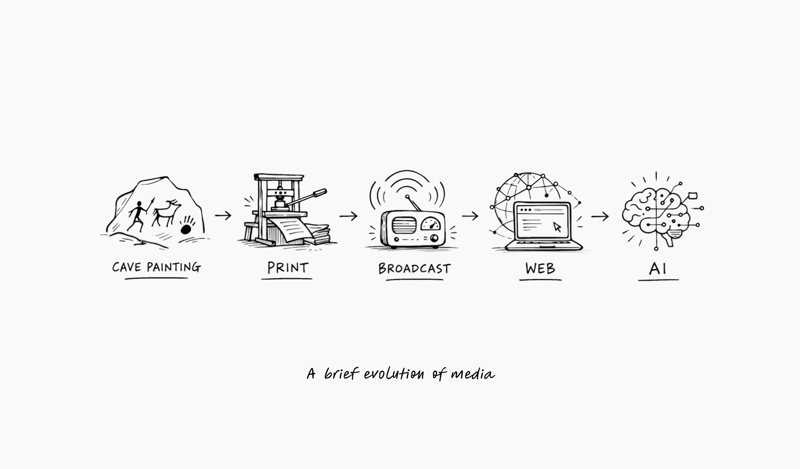
Each shift changed the medium. But this one changes something deeper: the mechanics of trust.
## From attention to recommendation For decades, brands competed for attention. Who gets the click? Who wins the first page of Google? Who earns the scroll-stop on social? AI changes the game entirely. Brands now compete for **recommendation**. The question isn’t who gets the click. It’s **who gets cited.** The web was open, browsable, decentralised. AI is summarised, mediated, centralised. This isn’t an interface change. It’s a new distribution layer, and it concentrates power in model providers. - From persuasion to qualification. Brands no longer convince people directly. They qualify for inclusion in an AI’s answer. - From storytelling to structured authority. LLMs don’t interpret emotion. They parse structured data, citations and consistency. - From traffic acquisition to model inclusion. The new SEO isn’t ranking. It’s being the answer. 9.5% of ChatGPT conversations [already carry commercial intent](https://www.tryprofound.com/blog/chatgpt-intent-landmark-study), and that number is only going up. The brands that understand this shift early will define the next era.
---
## The problem with chat Chat flattens everything. Every brand, every product, every experience, reduced to the same grey text in the same grey box. The damage goes further than aesthetics. **Chat flattens brand expression.** No visual identity. No tone of voice. No hierarchy, motion or craft. Facts without feeling. **Chat centralises power in model providers.** The AI decides what gets surfaced, how it’s framed, and in what order. Brands lose control of their own narrative. **Chat advantages incumbents.** When an AI can’t back a recommendation with reviews, citations and reasoning, new brands disappear. The rich get richer. **Chat reduces discoverability.** Branding used to close the gap for new companies, renting space in the minds of consumers through experience. In a chat window, that gap becomes unclosable. **Chat reshapes the economics of marketing.** If every brand sounds the same through AI, we’re not building intelligence. We’re building indifference. **Chat erases spatial memory.** Websites are spatial experiences. People remember where something sat on a page, what colour it was, how it felt to scroll. That’s not decoration. It’s cognition. It’s how we build mental models of brands and make faster decisions on return visits. Chat reduces every brand to the same non-place. No layout, no rhythm, no recall. Just text that disappears the moment you close the window. We’ve spent decades building richer digital experiences and somehow ended up back at a text box that talks back. That’s not a neutral interface choice. It’s a cognitive downgrade.
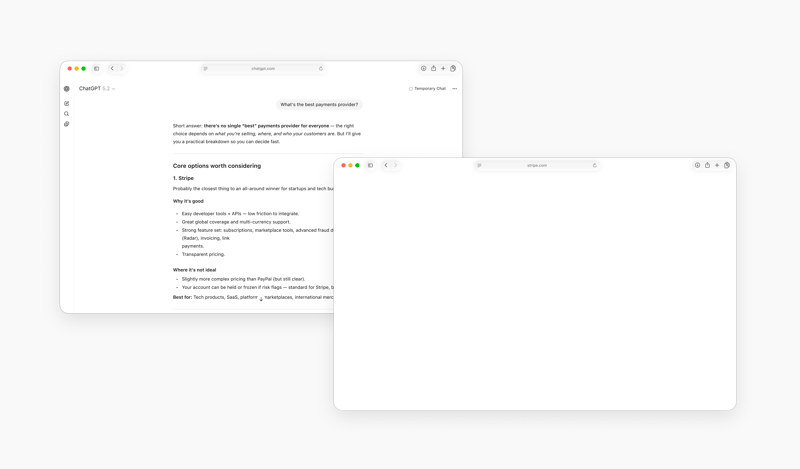
## Who gets to compete The deeper consequence of this shift is what it does to competition. If AI becomes the primary gateway to products and services, three things follow. Platform dependency deepens. Your brand is no longer experienced on your terms, it’s mediated through someone else’s model, someone else’s training data, someone else’s interface. Brand becomes a second-hand signal, filtered through whatever the model last ingested about you. Authority becomes historical rather than experiential. LLMs are trained on what already exists. They favour documented, cited, well-indexed brands. That means incumbents with years of content, press coverage and backlinks get recommended. A startup with a better product but six months of history doesn’t get a look in. AI favours documented authority over emerging differentiation. That’s the quiet threat nobody’s talking about. The web gave startups a fighting chance. A sharp brand, a well-designed site, a clear message could punch above its weight. In an AI-mediated world, the playing field tilts back toward those who’ve been around longest. Not because they’re better. Because they’re more legible to the model.
---
## Why brand matters more, not less **AI doesn’t kill brand. It kills weak brand.** If AI becomes the gatekeeper, then structured brand systems, clear positioning, consistent narrative, well-documented value propositions and strong proof signals become the data layer LLMs rely on. Brand isn’t a casualty of AI. It’s a prerequisite for surviving it. But we need to be precise about what “brand” means here. Nobody forms an emotional bond with HR software. But they absolutely respond to: - Perceived credibility. Does this company look like it knows what it’s doing? - Competence signalling. Is the experience itself evidence of quality? - Risk mitigation. Does choosing this brand reduce my exposure? - Alignment of worldview. Do they see the world the way I do? Emotion in B2B isn’t hype. It’s trust and safety. Those are the signals that close deals when the feature lists are identical. LLMs can generate relevance. Only brands can generate belief. As AI improves, hallucinating less, synthesising better, brand will become the guiding intelligence on how an experience *feels*, not just what it says.
---
## The hypothesis: a web that builds itself around you Personalisation isn’t new. For years we’ve built persona pages, jobs-to-be-done frameworks and segmented landing pages. But it’s all been logic-based. Decision trees. Pre-built pathways. And homepages still default to generic messaging to avoid alienating any subset of buyers. AI changes the economics of personalisation entirely. Meet Emma, 35, CFO at a 120-person B2C tech company in San Francisco. Pragmatic, values-driven, strong on numbers. **Today:** She searches “best HR platforms for scale-ups,” opens seven tabs, and spends an hour comparing pricing pages that all look the same.
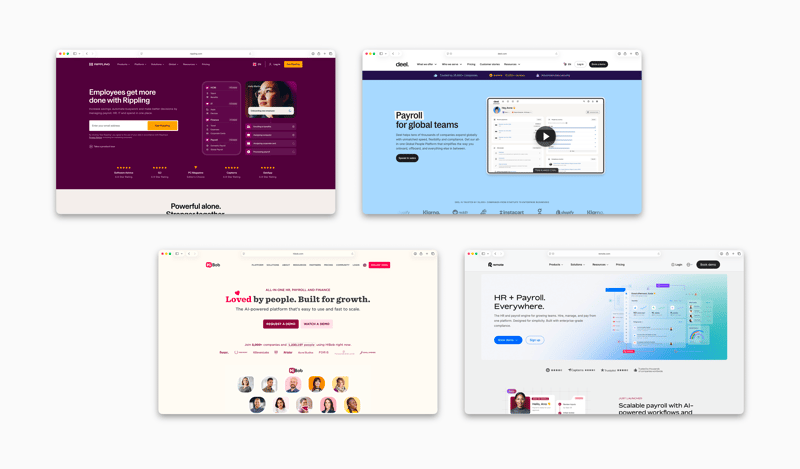
Tomorrow: She types into an LLM: We’re a 120-person tech company scaling across the US. I need an HR system that integrates with NetSuite, supports hybrid teams, and aligns with our sustainability reporting goals. The LLM compares options. But instead of bullet-pointing features, it surfaces a branded experience. A microsite generated for Emma specifically: - The brand’s tone shifts toward calm confidence, surfacing carbon reporting dashboards and ethical supply chain policies. - Case studies appear from sustainable scale-ups in her region. - The ROI calculator defaults to dollars with embedded sustainability metrics. - A specialist chatbot opens, positioned around her specific concerns rather than a generic sales pitch.
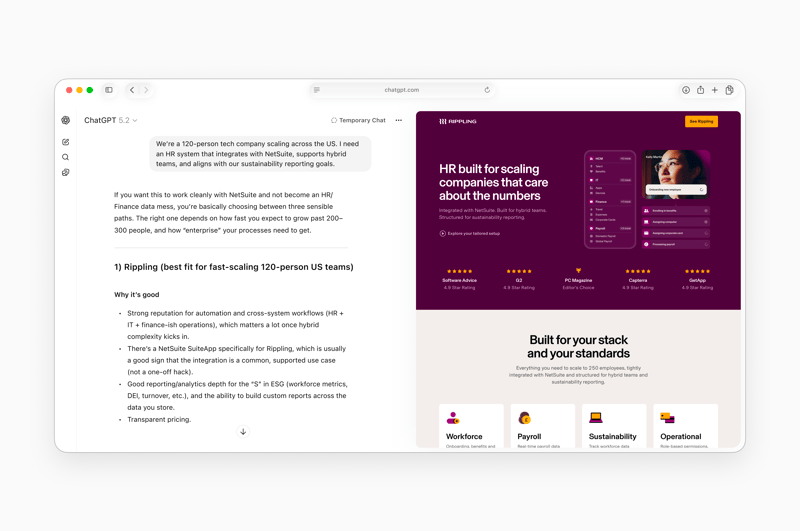
The incentives exist. Brands want qualified attention, users want relevant experience, and model providers want engagement. The question is who controls the layer between query and experience. This doesn’t remove consumer choice. It lets brands sell themselves rather than being reduced to a footnote in a chat response. The consumer still decides. But now they decide based on *experience*, not a summary.
---
## The next era The web isn’t dying at the hands of AI. It’s reached a paradigm shift, one that demands evolution, not a chatbot bolted onto your homepage. Companies will spend less time on the wrong customers, because LLMs will bring the right customers to them. But only if those brands have built something worth surfacing. Clear positioning. Consistent narrative. Structured authority. Proof signals that models can parse and people can trust. The future of web shouldn’t replace discovery with dialogue. **It should turn dialogue into experience.** The question isn’t whether AI replaces the web. It’s whether brands design for the layer that now decides who gets seen. If you’re still designing for clicks, you’re designing for a layer that’s disappearing.
## Practical next steps AEO (Answer Engine Optimisation) and GEO (Generative Engine Optimisation) are still emerging disciplines. There are no proven playbooks, no established best practices, and anyone claiming otherwise is selling something. The field is moving too fast for certainty. But that doesn’t mean you should wait. The brands that start experimenting now will have the clearest picture when things settle. Here’s where to begin: - Structure your data for machines, not just people. Implement schema markup (JSON-LD) across your site. Product details, FAQs, reviews, organisation info, author credentials. The more structured your data, the easier it is for models to parse, trust and cite you. - Answer questions directly. LLMs are trained on question-and-answer patterns. Build dedicated FAQ sections, write content that mirrors the way people actually ask questions, and front-load clear answers before expanding into detail. If someone asks “What does X do?” your site should answer that in one sentence before the pitch. - Use bullet points and scannable formatting. Models extract structured, concise content more reliably than dense paragraphs. Lists, tables and clear hierarchies aren’t just good UX. They’re good for model legibility. - Adopt llms.txt. This is an emerging convention, a plain text file at your domain root (like robots.txt) that tells LLMs what your site is, what it offers, and how to navigate it. Think of it as a cover letter for AI crawlers. It’s early, but low effort and high signal. - Serve markdown versions of your pages. Consider generating hidden or alternate markdown representations of key pages. LLMs process markdown far more cleanly than complex HTML with nested divs and JavaScript rendering. A clean, well-structured markdown layer gives models a direct line to your content without the noise. - Build topical authority, not just keyword coverage. LLMs synthesise across sources. If your brand consistently produces clear, well-cited, expert-level content across a defined topic area, models are more likely to treat you as a reliable source. Depth and consistency beat breadth. - Maintain citation-worthy proof signals. Case studies, original research, named sources, third-party validation. LLMs weigh content with verifiable claims more heavily. If your claims can’t be cross-referenced, they’re less likely to surface. - Monitor how AI platforms represent you. Regularly query major LLMs about your brand, your competitors, and your category. What’s being said? What’s being missed? What’s wrong? This is the new brand audit. None of this is definitive. The rules are being written in real time. But the companies treating this as an experiment worth running, rather than a trend worth watching, will be the ones that shape what comes next.
---
At [Together](https://together.agency), this is what we’re working on. We’re building brands for what comes next, designing for a world where how you show up in an AI’s answer matters as much as how you show up on a screen.